
The Centre for Health Protection of the Department of Health recently announced a sustained increase in the activity of Hand, Foot and Mouth Disease (HFMD). Since the start of the new academic year, outbreaks of HFMD in residential care homes/schools have been continuously rising week by week. The outbreaks are mainly concentrated in kindergartens, childcare centres, and primary schools. Citizens are urged to maintain personal and environmental hygiene at all times to prevent infection. Paediatrician Dr. Chan Yan-wing pointed out that October to December is also the peak season for HFMD each year.
Dr. Chan points out: "If children unfortunately contract hand, foot and mouth disease, their mouths will be covered in ulcers and they may experience fever, which is very painful for them. Hand, foot and mouth disease is caused by enteroviruses and is highly contagious, making it very easy to cause outbreaks within families. Therefore, we must take appropriate hygienic protective measures."
The peak season for Hand, Foot, and Mouth Disease is when?
Dr. Chen: The peak seasons for Hand, Foot and Mouth Disease are annually from May to August, and again from October to December.
Do only children get hand, foot and mouth disease?
Dr Chan: In fact, people of any age can contract Hand, Foot and Mouth Disease. Children are more susceptible because they often fail to maintain good hand hygiene and are more likely to be in contact with other children due to group living in schools.
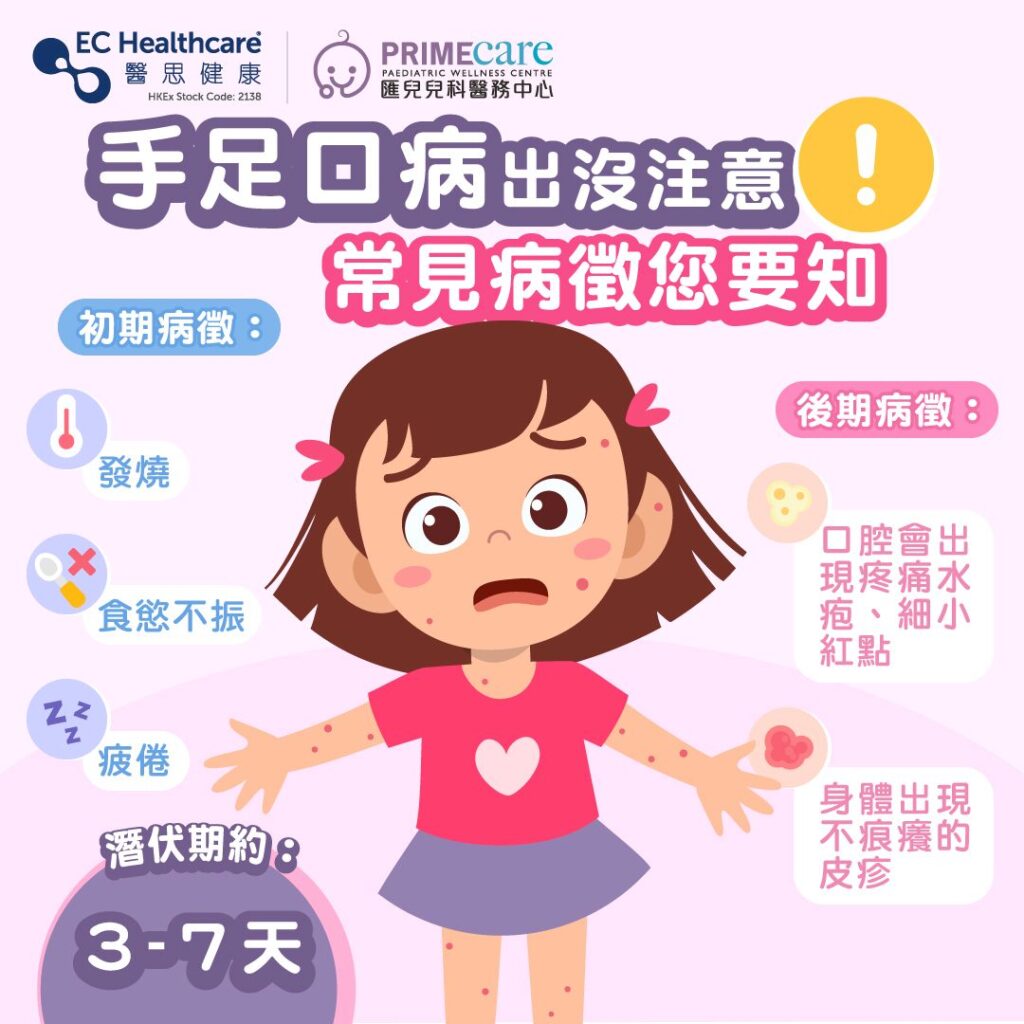
Hand, foot and mouth disease symptoms.
Dr Chan: Typically, when children contract hand, foot and mouth disease, the first symptom is a high fever, which can reach 39 or 40 degrees Celsius. Following this, they will experience a sore throat, with many red spots, ulcers, and mouth sores appearing inside their mouths. These symptoms will gradually spread to the hands and feet, though the specific areas affected will depend on which enterovirus caused the illness.
Question 4: What can parents do when their child is ill?
Dr. Chan: When parents see their child's mouth full of mouth ulcers, making it impossible to eat normally, they can try giving them some cold foods, such as cold milk, yoghurt, jelly and ice cream. In addition, parents must be very careful to prevent the whole family from getting infected, as once a child has vomiting due to enterovirus or hand, foot and mouth disease, the virus can potentially spread to others through contaminated items. Therefore, we should clean potentially contaminated areas with a 1:49 disinfectant.
Problem 5: Can infection provide lifelong immunity?
Dr. Chen: Some people may think that once you get hand, foot and mouth disease, you gain lifelong immunity. However, in reality, because there are many different types of enteroviruses, even if you have been infected before, it does not guarantee that you will not get sick again. I have many patients who get hand, foot and mouth disease almost every year, so we must always remain vigilant and ensure good hygiene.
Furthermore, a Centre for Health Protection spokesperson said, "As young children are susceptible to infection, parents should pay closer attention to their children's health. Children in schools and institutions have close contact, which makes it easier for diseases to spread and outbreaks may occur." The Centre for Health Protection will issue letters to child care centres, kindergartens, primary schools and secondary schools, appealing to them to pay attention to the latest situation. Schools must implement preventive and control measures and handle outbreaks in accordance with the "Guidelines on Prevention and Control of Communicable Diseases". Outbreaks should be reported to the Centre for Health Protection for timely follow-up.
Playground managers should pay special attention to the "Public Health Recommendations for Play Facilities" issued by the Centre for Health Protection, and implement appropriate infection control measures when organising activities for children under six years old during peak periods. A spokesperson for the Centre for Health Protection reminded the public that because alcohol is not effective in killing some viruses that cause hand, foot and mouth disease (e.g., Enterovirus 71), alcohol-based hand sanitisers cannot replace washing hands with soap and water. To prevent the infection of hand, foot and mouth disease, the public (especially staff in institutions) should take the following measures:
- Keep the air circulating.
- Wash hands before eating, after using the toilet, and after handling nappies or other soiled items.
- Keep your hands clean and wash them correctly. Wash your hands immediately, especially after your hands have been contaminated with respiratory secretions (e.g., after sneezing);
- Cover your mouth and nose when you sneeze or cough, and dispose of nasal and oral secretions properly.
- Clean and disinfect frequently touched surfaces, such as furniture, toys and shared items, on a regular basis.Use a 1:99 dilution of household bleach (i.e. mix 1 part bleach containing 5.25% sodium hypochlorite with 99 parts water) to disinfect; leave for 15 to 30 minutes, then rinse with water and wipe dry;
- Use highly absorbent disposable wipes to remove visible soiling, such as respiratory secretions, vomit or faeces,then use household bleach diluted at a ratio of 1:49 (i.e. mix 1 part bleach containing 5.25% sodium hypochlorite with 49 parts clean water) to disinfect the contaminated area and the surrounding areas; leave for 15 to 30 minutes, then rinse with water and wipe dry;
- Sick children should remain at home until their fever and rash subside, and all blisters have crusted over, before returning to school.
- Reduce to crowded places;
- Parents should keep in close contact with the school to keep it informed of the sick child's latest condition.
Source: Learn More – GoStudy.HK (5 October 2023): https://www.gostudy.hk/4703/