
Paediatric surgery

- Circumcision (commonly known as having your foreskin removed)
- Inguinal hernia surgery (commonly known as a groin hernia)
- Hydrocele repair (commonly known as water in the scrotum)
- Undescended testicle repair
- Umbilical hernia repair
- Tongue-tie release surgery (commonly known as snipping the tongue-tie)
- Excision of lump
Tongue-tie release (frenulotomy)
Tongue-tie is a condition where a baby's tongue movement is restricted from birth. Medically, the lingual frenulum refers to a thin membrane under the tongue that attaches to the floor of the mouth, helping to stabilise and allow the tongue to move flexibly. An abnormal condition occurs when the frenulum is thin but too short, clinically known as ankyloglossia or tongue-tie, which can affect a baby's speech development. Furthermore, due to the baby's limited tongue movement, it can cause damage and bleeding to the mother's nipples during breastfeeding, increasing the likelihood of mastitis.
Regarding medical treatment, this condition requires surgical intervention. Doctors will decide whether to use general or local anaesthesia based on the patient's age and individual circumstances. "Cutting the tongue tie" is actually a frenotomy, where the frenulum is cut with surgical scissors. This is a relatively minor procedure for newborns, involving less bleeding and pain, and a quicker recovery time. Babies can resume normal feeding immediately after the surgery. In addition to surgical intervention, laser technology and other treatment methods are also available. Please consult your doctor for more details.
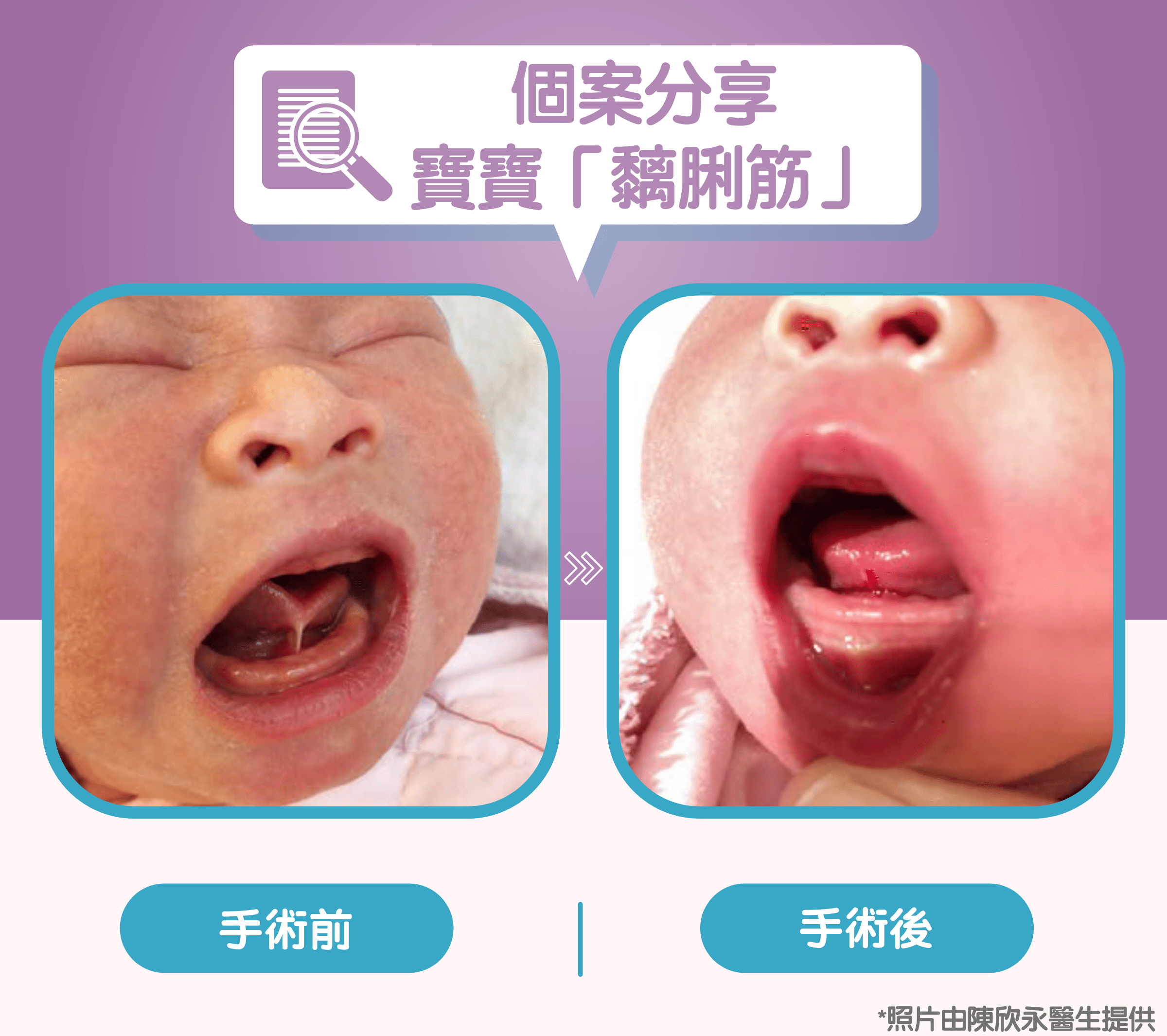
💡Fun fact: In fact, around 5–10 per 1,000 newborns suffer from a shortened lingual frenulum, and this condition is generally more common in boys. Clinically, there are various tools and assessment methods to determine the severity. Put simply, if you suspect your baby has a ‘short frenulum’, you can check the frenulum when your newborn opens their mouth to cry, noting whether they can stick their tongue out and whether the tip of their tongue forms a ‘W’ or‘heart-shaped’ formation at the tip of the tongue
Due to a short lingual frenulum, the tongue's range of motion is restricted, causing the tip of the tongue to split. As the ability to move the tongue upwards is also affected, pronunciation issues can occur when uttering certain alveolar sounds such as "d" (as in "da" or as in "do") or "t" (as in "ta" or as in "ten").
If parents have any doubts, it is recommended that they first take their baby to a paediatrician for examination and assessment.
Circumcision
The foreskin (or prepuce) is a double-layered fold of skin that covers the head of the penis. It grows along with the penis during fetal development, protecting the glans and preventing external injury or impact. The speed of foreskin growth varies from person to person. Under normal circumstances, the foreskin covers the glans when the penis is not erect, and it can be easily pulled back to reveal the penis. When erect, the entire glans may be automatically exposed.
The foreskin of newborn babies generally cannot be retracted; by the age of 3, approximately 50% are able to retract their foreskin,Generally, boys are able to gradually retract the foreskin by the age of 4 to 5, and by the time they reach puberty at around 12–13 years of age, approximately 90% or more are able to retract the foreskin.

Circumcision might be considered in several situations: * **Medical Reasons:** * **Phimosis:** This is when the foreskin is too tight to be pulled back over the head of the penis. It can cause pain, difficulty with hygiene, and problems during urination or sexual intercourse. * **Recurrent Balanitis or Balanoposthitis:** These are infections of the head of the penis (glans) and the foreskin. If they keep happening, circumcision can prevent further infections. * **Paraphimosis:** This is a medical emergency where the foreskin gets stuck behind the head of the penis and cannot be pulled forward. This cuts off blood flow and requires immediate medical attention, sometimes leading to circumcision. * **Urinary Tract Infections (UTIs):** In some cases, recurrent UTIs in infants have been linked to the foreskin, and circumcision might be considered to reduce the risk. * **Penile Cancer:** While rare, circumcision can reduce the risk of penile cancer. * **Religious or Cultural Reasons:** Circumcision is a religious tradition for Judaism and Islam. It may also be performed for cultural reasons in some communities. * **Personal Preference or Preventative Measures:** Some parents choose circumcision for their sons for aesthetic reasons or based on the belief that it offers long-term hygienic benefits or reduces the risk of certain sexually transmitted infections (STIs) later in life, although the extent of these benefits is debated.
In normal circumstances, the foreskin can be retracted to expose the glans when the penis is erect. If the foreskin is too tight, with an opening smaller than the glans, or if it cannot be retracted to expose the glans even with manual assistance, then this surgery should be considered.
Circumcision is a surgical procedure that involves removing the foreskin, the retractable fold of skin that covers the tip of the penis. The decision to perform circumcision can be based on several factors: * **Medical reasons:** In some cases, there may be medical indications for circumcision, such as severe phimosis (a condition where the foreskin is too tight to be retracted), balanitis (inflammation of the glans), or recurrent urinary tract infections. * **Cultural or religious reasons:** Circumcision is a common practice in certain religions and cultures, often performed for religious or traditional reasons. * **Personal preference:** Some parents choose to circumcise their sons for personal or aesthetic reasons. The decision is usually made in consultation with a healthcare professional, who can discuss the potential benefits, risks, and alternatives of the procedure.
Circumcision is the surgical removal of the foreskin that is too tight around the head of the penis, thereby exposing the glans. The formal medical term for this procedure is "circumcision," and there are no age restrictions. It has no impact on the body or sexual life. As for whether or not to have a circumcision, this should only be decided after a doctor's diagnosis.
How to retract the foreskin for cleaning.
Simply retract the foreskin to expose the glans and wash with mild soap. If the foreskin is too tight to retract and clean, circumcision should be considered.
At what age can the foreskin be retracted?
Generally, between the ages of 4 and 5, the foreskin and glans gradually separate in most males, but the exact age at which the foreskin can be retracted varies from person to person. The length of the foreskin also varies; some individuals may have a foreskin that is too long or too tight, meaning it may never be able to be retracted. If this situation persists into adolescence, it is best to seek medical advice.
Childhood hernia
Paediatric inguinal hernias are one of the most common conditions in paediatric urology. Do not assume that inguinal hernias—commonly known as ‘inguinal hernias’—only occur in adults; in fact, they can also occur in infants and young children.Data from international studies indicate that the incidence of inguinal hernia in full-term infants is approximately 3% to 5%, whilst the incidence in preterm infants is about 30 per cent higher.This is caused by a passage or opening in the child’s inguinal region—the ‘groin’—that has not closed properly, allowing abdominal organs to protrude through this passage and form a hard lump or swelling in the groin.These organs may include the large intestine, small intestine, ovaries, uterus and bladder; in severe cases, this can lead to acute complications such as intestinal obstruction.As paediatric hernias can occur in early childhood or even during infancy (affecting approximately 2–7% of children), parents should not ignore any concerns and should take their child to see a doctor as soon as possible.
Further research indicates that hernias are also a common cause of children requiring surgery for acute abdominal pain, demonstrating that hernias are the most common surgical condition in infants and young children. Clinically, hernias are relatively more common in boys than in girls.

Inguinal hernias require surgery to resolve.
Inguinal hernias generally do not heal naturally. In fact, with current technology, performing surgery for a baby's inguinal hernia is not a major issue. If the condition is left to develop and complications such as intestinal obstruction or bowel necrosis occur, it would be more dangerous for the child.
Keyhole hernia surgery
Minimally invasive surgery has become more prevalent for hernias in the past 10-20 years, and the changes it has brought include:
The wound is smaller and heals faster.
2. Generally speaking, scars are not very noticeable after a wound has healed. Nowadays, instruments as small as 3mm can be used to perform internal suturing, and most children's wounds leave no trace whatsoever after being closed.
3. If an inguinal hernia occurs on one side, the risk of it occurring on the other side also increases; in the case of premature babies, this risk may be as high as 10–20%;Endoscopy, which is used in minimally invasive surgery, allows the surgeon to clearly see whether there are signs of a hernia on the other side. If so, this can be treated at the same time as the initial operation, meaning the child will not need to undergo two separate operations.
Traditional open surgery
However, not every child is suitable for minimally invasive surgery. The following two situations may not recommend the use of minimally invasive surgery for inguinal hernias, and traditional open surgery may be more suitable:
Some very premature babies may not be suitable due to their weak cardiopulmonary function.
2. If the baby has had previous abdominal surgery with adhesions, it may not be suitable.
Paediatric minimally invasive surgery
- Laparoscopic inguinal
- Hernia repair surgery (commonly known as laparoscopic inguinal hernia repair surgery)
- Laparoscopic appendicectomy (commonly known as laparoscopic appendicitis removal)
- Laparoscopic intussusception surgery
- Laparoscopic-assisted resection of Meckel's diverticulum
- Laparoscopic-assisted repair of undescended testis
- Laparoscopic varicocele surgery
- Cystoscopy
Urology
- Surgical treatment for various penile abnormalities
-
- Buried penis
- Peyronie's disease
- Penile torsion
- Hypospadias repair
- Varicocele surgery
- Cystoscopy
- Vesicoureteral reflux surgery
- Post-urethral surgery
- Renal pelvis and ureter junction obstruction surgery
Gastroenterology and Hepatobiliary Medicine
- Gallstones
- Biliary atresia
- Bile duct cyst
- Megacolon
- Gastro-oesophageal reflux
- Oesophagogastroduodenoscopy
- Colonoscopy
- Endoscopic Surgery (Biopsy, Foreign Body Removal, Intestinal Bleeding Treatment, and Polypectomy)
Emergency paediatric surgery
- Traumatic wound
- Burns
- Abscess/soft tissue infection
- Incarcerated/strangulated inguinal hernia
Congenital malformation correction surgery
Neonatal surgery
Paediatric surgical oncology
- Angioma
- Teratoma
- Lymphatic malformation
- Venous malformation
- Capillary malformation