Flat Feet
Definition
- Flat feet refer to the dropping of the navicular bone and the collapse of the medial arch, leading to an inability to effectively bear weight and causing foot pronation. A lack of arch in the medial arch causes the sole of the foot to lie flat on the ground, hindering the arch’s original shock-absorbing function and affecting the forces on the lower limbs. This can potentially lead to compensatory symptoms and cause pain in the waist or lower limbs.
- Flat feet are mainly divided into functional flat feet (flexible flatfoot) and structural flat feet (rigid flatfoot).
- Acquired flexible flatfoot
- When the sole of the foot bears weight, the arch collapses; essentially, the arch maintains its curvature when the sole is not bearing weight.
- Structural flatfoot (rigid flatfoot) - congenital
- The arch collapses even when the sole of the foot is not bearing weight.
- Acquired flexible flatfoot
Cause
- The arch develops between the ages of 6 to 10, so flat feet are very common in children and will improve significantly as the arch develops. However, a small number of adults may develop flat feet later in life due to acquired factors, such as ageing or weight gain.
- Causes of functional flat feet include:
- Excess weight puts too much strain on the arches of the feet.
- The tendons and muscles are not strong enough to support the arch of the foot.
- Tibialis posterior tendinitis: Inflammation affects the tibialis posterior muscle's ability to perform toe plantar flexion, inversion, and other actions, making it difficult to maintain the shape of the medial arch of the foot.
- Arthritis
- Diabetes
- Excessive range of motion in the temporomandibular joint
- Causes of structural flat feet include:
- Congenital ligamentous laxity resulting in ineffective joint stabilization
- Congenital tarsal coalition: union of calcaneus and talus
- Residual factor
Common symptoms
- In the early stages, flat feet do not have obvious symptoms, but when patients stand or walk excessively, the arch of the foot is unable to effectively absorb shock and support the body's weight. Over time, patients may develop compensatory symptoms in their ankle joints, knee joints, or hip joints. For example:
- Numbness, tingling, and pain in the feet
- When walking, parallel force is weaker.
- When walking, the feet may turn inwards or outwards, and the knees may appear knock-kneed (X-shaped legs).
- Other compensatory complications: plantar fasciitis, bunions, knee joint or lumbar spine lesions
Method of handling
- Strengthening the muscles of the soles of the feet, calves, and thighs helps support the feet.
- Using orthotic insoles to improve foot shape
- If compensatory symptoms and pain arise due to flat feet, physical therapy can use ice packs, massage, manual therapy, and electrotherapy equipment to reduce pain and inflammation.
- Only a very small number of cases require surgery to treat flat feet.
Precautions
- Choose footwear with effective arch support to alleviate foot pain and fatigue caused by strenuous exercise.
- Leg exercises to strengthen thigh, calf, and sole muscles, tendons, and ligaments
- Stretch the toe tendons and arch of the foot
- Children who are still in the developmental stage can have regular foot assessments to check and monitor the development of their foot arches.
- Maintain a normal body weight to avoid placing excessive strain on your feet.
Radial head subluxation (commonly known as nursemaid's elbow/pulled elbow)
Definition
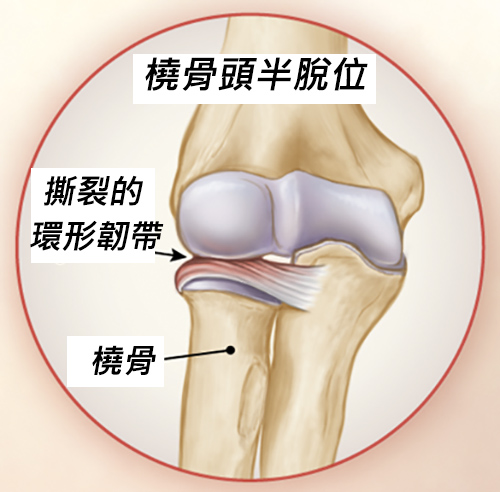
- Most commonly seen in children aged 1 to 5 years, the main cause is a sudden pull on the child's arm, resulting in a subluxation of the radial head, which slips out of the annular ligament, causing the torn annular ligament to become trapped within the radiocapitellar joint.

Cause
- This often happens when playing swinging games by holding a child's hand, pulling them up by their hands, or when parents suddenly pull their hands to prevent them from overexerting themselves. It can also be caused by some improper movements, such as incorrect angles when putting on or taking off clothes or jackets, or when they wave their arms around.
Incentive
- Hypermobility of ligaments or joints
- Further injury with incomplete ligament healing
Common symptoms
- A child's arm has suddenly become immobile, and moving or touching his arm causes him to cry uncontrollably.
- Arms held close to the body, forearms bent inwards, the person sometimes supports their elbow by holding their own wrist.
- Severe pain in the elbow and forearm, with complete limitation of joint movement.
Method of handling
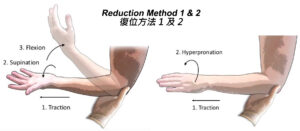
- Joint reduction using physiotherapy can usually relieve a child’s pain within a short period of time; however, other conditions—such as upper limb fractures, osteomyelitis, cellulitis or tumours—must first be ruled out.If there are obvious signs of trauma to the arm, such as redness, swelling or a lump, other conditions must be considered. Common joint reduction techniques are categorised as excessive pronation or supination/flexion.There is a high probability of successful reduction, but recurrence is also common. For several weeks following reduction, parents should avoid suddenly pulling on the child’s arm and should advise the child not to swing their arm with excessive force.In addition, it is advisable to use physiotherapy treatments such as electrotherapy or cold compresses to reduce acute inflammation and relieve pain. Subsequently, joint range of motion can be gradually restored through exercise.

Precautions
- Avoid sudden pulling on a child's arm or performing high-risk movements that can easily cause radial head subluxation.
- Warm up before exercising, and improve muscle strength and flexibility.
Trigger finger (also known as stenosing tenosynovitis of the flexor tendons)
Definition
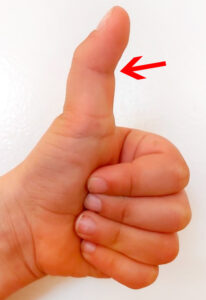
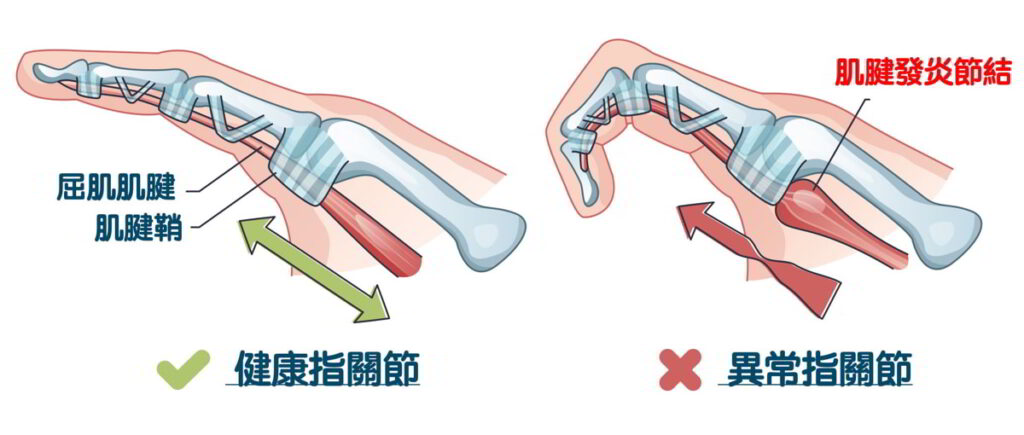
A condition where the finger is unable to flex or extend freely because the tendon is caught as it slides through the sheathe within the joint, caused by repetitive motion or inflammation of the finger tendons. In chronic stages, the synovium around the finger tendons becomes inflamed, thickened, or calcified, making it very difficult for the tendon to slide smoothly again. Patients describe their finger as getting stuck or like pulling a trigger, hence the common names "trigger finger" or "snapping finger".
Cause
Repetitive strain, prolonged repetitive finger movements, a history of hand arthritis, or congenital structural problems
Incentive
- Young children with delayed fine motor development, especially infants under 6 months.
- Older adults, women with reduced physical strength
- For people who easily strain their finger joints due to work and exercise, or who experience repercussions from poorly healed finger injuries.
- People with diabetes
Common symptoms
- Finger pain, a feeling of catching or popping, and in severe cases, inability to fully bend or straighten.
- Fingers are particularly stiff or difficult to move upon waking up in the morning.
- Fingers may swell or develop lumps.
Method of handling
- Physiotherapy such as ice therapy, hot compresses, ultrasound therapy, and laser therapy helps to reduce inflammation and promote recovery.
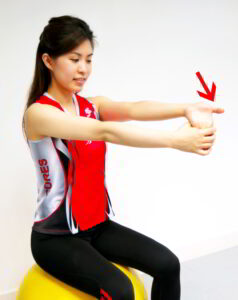
- Finger extension exercises help improve tendon sticking, trying to pull the tendon back into the correct position as much as possible.
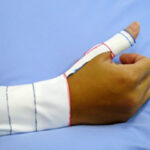
- For delayed development of small muscles or tight/weak tendons, muscle strengthening exercises should be performed frequently. Hard plastic supports can also be used to moderately protect the tendons.
- In severe cases, anti-inflammatory drugs or steroid injections can be used to alleviate symptoms.
- If an infant's trigger finger does not improve over a long period, a minor surgery to cut open the tendon sheath can be considered to ensure normal development and prevent finger deformity.
Precautions
- Parents should pay more attention to whether the infant's fingers exhibit abnormal movements or are avoided.
- Avoid overworking your fingers and do more finger joint stretching exercises.
- If you have a history of conditions such as diabetes or arthritis, pay extra attention to caring for your finger joints.