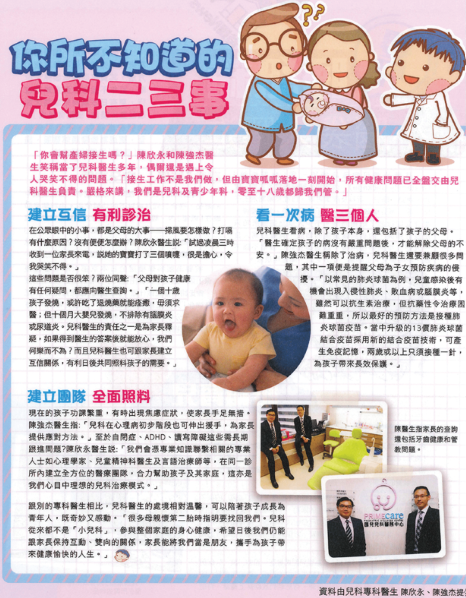
"Will you assist with childbirth?" Dr. Chan Yan-wing and Dr. Chan Keung-kit, who have been paediatricians for many years, joked that they still encounter amusing questions from time to time. "We don't deliver babies, but from the moment a baby is born, all health issues are entirely the responsibility of paediatricians. Strictly speaking, we are paediatric and adolescent specialists, covering ages zero to eighteen."
Building mutual trust is beneficial for diagnosis and treatment.
What seems like a small matter to the public is a big matter to parents. — How to burp your baby? What causes hiccups? What to do if your baby hasn't pooped? Dr. Chan Yan-yung said: "I once received a call at 3 AM from a parent whose baby had sneezed three times and they were very worried. It made me laugh and cry at the same time."
Are these questions silly? Both agree: "Parents should consult a doctor with any questions about their child's health." "A ten-year-old child with a fever might recover with antipyretics without needing to see a doctor; but a ten-month-old baby with a fever could potentially have meningitis or a urinary tract infection. One of a paediatrician's responsibilities is to allay parents' concerns, and if they can be reassured by the doctor's answer, why wouldn't we help? Furthermore, paediatricians can build a trusting relationship with parents, which is beneficial for jointly managing the child's needs in the future."
Seeing a doctor treats three people.
When paediatricians treat a child, they are not just treating the child but also the parents. "Only after the doctor confirms that the child's illness is not a serious problem can the parents' anxiety be relieved." Dr. Chen Qiang-jie stated that in addition to treating illnesses, paediatricians must also consider many other issues, one of which is reminding parents to prevent their children from being affected by diseases. "Taking pneumococcal disease as an example, children infected with it may develop invasive pneumonia, septicaemia or meningitis. Although it can be treated with antibiotics, drug resistance makes treatment very difficult. Therefore, the best way to prevent it is to get the pneumococcal vaccine. The upgraded 13-valent pneumococcal conjugate vaccine uses new conjugate vaccine technology to generate immune memory. Children aged two or above only require a single dose, providing long-lasting protection."
Build a team, provide comprehensive care
Today's children have heavy schoolwork, and sometimes show symptoms of anxiety, leaving parents at a loss. Dr. Chan Keung-kit points out, "Paediatrics can also offer help in the early stages of psychological illness, providing parents with coping strategies." As for long-term issues such as autism, ADHD, and dyslexia? Dr. Chan Yan-wing says, "We use our professional knowledge to connect with relevant specialists such as psychologists, child psychiatrists, and speech therapists, establishing a comprehensive medical team within the same clinic to collaboratively help children and their families. This is also the ideal paediatric treatment model in our minds."
Compared to doctors in other specialties, paediatricians are in a rather heartwarming situation, able to accompany children as they grow into young adults, which is both wonderful and deeply moving. "Many mothers specifically ask to see us again when they're expecting their second child. Paediatrics has never been a 'minor' field; it involves the mental and physical well-being of the entire family. We hope to maintain an interactive, two-way relationship with parents in the future, so that they see us as friends, and together we can bring about a healthy and happy life for their children."
Paediatric Specialist Dr Chan Yan Wing