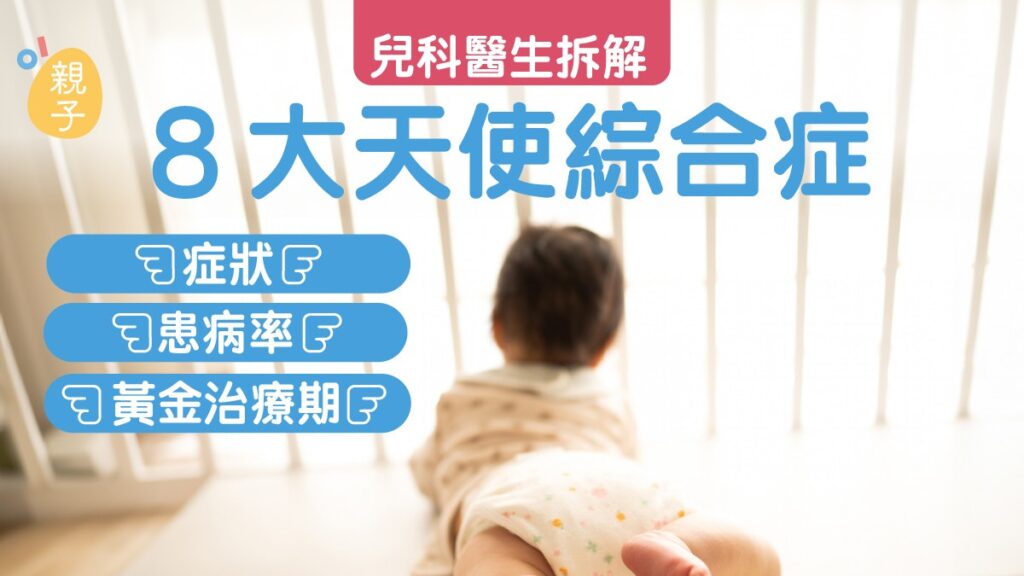
Recently, artistes Fred Cheng and Stephanie Ho revealed that their son has been diagnosed with the rare genetic disorder "Angelman Syndrome". Dr. Chan Yan-wing, a Paediatric Specialist, shares more information on how Angelman Syndrome affects a child's future growth and development, and how parents can cope with and manage the condition.
Article author: Dr. Bosco Chan, Paediatric Specialist
Angelman syndrome (Happy puppet syndrome) is what?
Angelman Syndrome is a rare genetic disorder. The reason it is named Angelman Syndrome is that in 1965, a British doctor named Dr. Harry Angelman observed three children who all exhibited similar symptoms. These included physical stiffness, unsteadiness when walking, and developmental delays in speech leading to an inability to speak. At the same time, they displayed excessive laughter throughout the day, coupled with seizures. Dr. Harry published an article describing the similar symptoms observed in these three children. As medical technology advanced, it was discovered that this condition was related to a genetic defect, and thus, following Dr. Harry's discovery, the disorder was named Angelman Syndrome.
Angelman syndrome is sporadic or hereditary?
In 1997, scientists discovered and determined that Angelman Syndrome is caused by mutations in the UBE3A gene located on chromosome 15. The primary cause of Angelman Syndrome is a defect in the maternal copy of chromosome 15 within the 15q region, or from inheriting two defective copies of chromosome 15 from the father. Conversely, if the genetic defect originates from the father, or if both chromosomes 15 inherited from the mother carry defects, it results in Prader-Willi Syndrome. This is the opposite from Angelman Syndrome, as Angelman Syndrome is caused by issues with the maternal copy of chromosome 15. On the other hand, Prader-Willi Syndrome arises from genetic defects in the paternal copy. This type of genetic mutation is mainly due to a deletion, but can also be caused by changes or deletions in the UBE3A gene, imprinting errors, or the effect of uniparental disomy. A small proportion can also be caused by other chromosomal rearrangement factors.
What is the approximate global and Hong Kong prevalence rate?
Approximately how many new cases are diagnosed in Hong Kong each year?
Angelman Syndrome is not a common disease, with approximately one in 15,000 children worldwide having the chance of being diagnosed with Angelman Syndrome. In Hong Kong, there are about 3-5 confirmed cases annually.
The typical age of onset and diagnosis is between X and Y years old. Is the condition more common in boys or girls?
Angelman syndrome is caused by a genetic mutation. It can be sporadic, meaning that neither parent has a genetic issue, but the child unfortunately develops a gene mutation. The incidence rate is the same for both males and females. Because the symptoms can vary, some cases may not be immediately diagnosed. However, most children will show similar symptoms around the ages of two to five years old. The main reason for diagnosis is that parents often notice developmental delays in their children, and these developmental issues may not be very obvious in the early stages. The most common age for diagnosis is between two and five years old, as the symptoms become more apparent around that time.
Angelman syndrome symptoms
In terms of appearance, some children with Angelman Syndrome have wider mouths, spaced-out teeth, and more prominent chins. They may stick their tongues out frequently and not close their mouths, leading to feeding and swallowing difficulties. Patients often appear excessively cheerful and laugh often. Around 80% of children with Angelman Syndrome also experience seizures. They may also have developmental delays, a lack of language ability, speech impairments, hyperactivity, and intellectual disabilities. More than half of children may have microcephaly, where their heads are smaller than average. The above are potential symptoms and issues that children with Angelman Syndrome may experience, with some children also suffering from sleep disorders, strabismus, and feeding problems.
Golden period for treating Angelman syndrome
A general diagnosis is a clinical diagnosis, involving the observation of facial features and symptoms, combined with clinical diagnosis and family history. When symptoms of Angelman syndrome appear, a doctor will make a suspected diagnosis. Blood tests will be conducted to check for gene mutations, deletions, etc., that may be causing the various conditions. Mothers also undergo prenatal screenings during pregnancy to check if their child may have different diseases, including Angelman syndrome. However, the accuracy of tests for Angelman syndrome is not 100%. Some gene mutations may not be detected accurately. Therefore, even if prenatal examinations do not reveal any problems, but the child still exhibits symptoms, it does not definitively mean the child does not have Angelman syndrome. Thus, if parents notice that their child has developmental delays or even experiences seizures or epilepsy, along with other characteristics, they should seek medical attention as soon as possible for a diagnosis, which may include specific genetic testing to determine if they indeed have Angelman syndrome.
Angelman syndrome treatments
Angelman syndrome is a genetic condition, so for the time being, there is no medical cure for Angelman syndrome. In terms of treatment, doctors will provide appropriate treatment based on the severity of the child's condition. For example, if a child has developmental delays, whether it be in gross motor skills, fine motor skills, or language development in various aspects, they will need to undergo early childhood development training. This aims to help with their gross and fine motor development, communication skills with others, and other areas. The earlier the treatment, the more it is hoped that the child's developmental potential can be maximised. As for other aspects, for instance, if a child experiences seizures or epilepsy, doctors will need to appropriately use medication to control the epilepsy. Different targeted treatments will be provided according to the child's condition. If a child has feeding issues, we will teach them swallowing techniques in the hope of improving swallowing. Therefore, doctors will follow the child's clinical presentation and provide appropriate treatment. However, Angelman syndrome is a genetic condition, so currently, there is no medicine available that can provide a cure.
How should parents handle and face this?
For parents, the pressure they face is immense and exceedingly challenging. The journey from initially suspecting developmental issues in their child, to suspecting Angelman Syndrome, to seeing doctors for assessments, followed by diagnoses and examinations, and finally receiving a confirmed diagnosis, is a very difficult process. At such times, parents need to encourage each other immensely, must not lose heart, and should face it proactively. Hong Kong now has some support groups, so we also recommend that if a child is unfortunately diagnosed, they should seek appropriate treatment as soon as possible. The Angelman Syndrome Foundation Hong Kong provides suitable assistance, and there are also many support groups in Hong Kong. Try to talk and discuss with other parents, share the problems you encounter, share how to manage them, and whether there are any better solutions. Different family support is extremely important. Therefore, for parents whose children have truly been diagnosed with Angelman Syndrome, the pressure will be great. So, it's important to discuss with doctors as early as possible about how to help children with developmental training and treatment for epilepsy, sleep, and feeding, as well as to provide support for the family, physiologically and psychologically.
Source: 【Hong Kong 01 · 01 Parent-Child】 (18th June 2024) : https://tinyurl.com/4d9jj95w