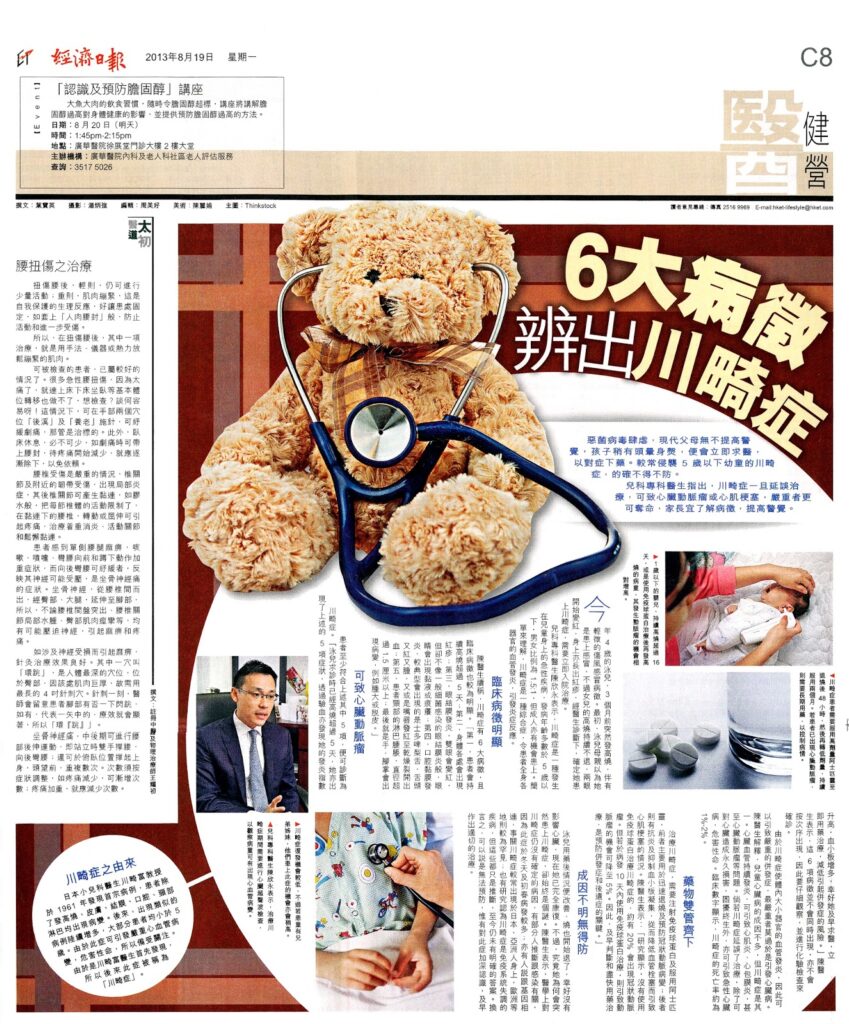
With the rampant spread of germs and viruses, modern parents are on high alert. If their children show even the slightest sign of feeling unwell, they immediately seek medical attention to get the right treatment. Kawasaki disease, which frequently affects children under 5, is indeed something that must be guarded against.
Paediatric specialists point out that Kawasaki disease, if left untreated, can lead to coronary artery aneurysms or myocardial infarction, and in severe cases, can be fatal. Parents should be aware of the symptoms and remain vigilant.
Chloe, aged 4, suddenly developed a high fever three months ago, accompanied by mild cold symptoms. Initially, Chloe's mother thought she had a cold, but her daughter's fever persisted, her eyes began to redden, and she developed a rash. After a doctor's diagnosis, she was confirmed to have Kawasaki disease and required immediate hospitalisation for treatment.
Paediatric specialist Dr. Chan Yan-wing stated that Kawasaki disease is an acute illness that occurs in children, mostly affecting those under 5 years of age. The male-to-female ratio is 1.5:1, though adults can also contract the illness. To put it simply, Kawasaki disease is a syndrome that causes inflammation of blood vessels in all organs of the patient's body, triggering an inflammatory response.
Obvious clinical signs
Dr Chan continued to explain that Kawasaki disease has six major symptoms, and the clinical signs are relatively obvious. "First, the patient will have a persistent high fever exceeding 5 days; second, rashes will appear all over the body; third, the eye conjunctiva will become inflamed, and the eyes will turn red, but unlike typical bacterial conjunctivitis, the eyes will not produce mucus or itch; fourth, the oral mucosa will become inflamed, typically presenting as a strawberry tongue, with the tongue appearing red and swollen, or the lips becoming red, dry, cracked and bleeding; fifth, the lymph nodes in the neck will swell, with a diameter exceeding 1.5 centimetres; finally, there will be changes in the palms of the hands and soles of the feet, such as swelling or peeling."
Can cause an aortic aneurysm
A diagnosis of Kawasaki disease can be made if the patient meets at least 5 of the above criteria. "When singer Vincy Yeung sought medical attention, she had a high fever for more than 5 days. She also exhibited 5 of the above symptoms. Blood tests revealed elevated inflammatory markers and an increased platelet count. Fortunately, she sought medical help early and was treated with medication immediately, reducing the risk of complications." Dr. Chan stated that these 6 symptoms do not appear simultaneously nor in a specific order, so careful observation and laboratory tests are necessary for a definitive diagnosis.
As Tetralogy of Fallot causes inflammation of the blood vessels in organs throughout the body, it can lead to serious complications, the most severe of which is heart disease. Dr Chen explained that whilst there are few causes of heart disease in children, Tetralogy of Fallot is one of them.Persistent inflammation of the heart’s blood vessels can lead to conditions such as myocarditis, pericarditis and even cardiac aneurysms. If treatment for Kawasaki disease is delayed, it can not only cause permanent damage to the heart, leading to lifelong complications, but may also result in acute heart disease, which can be life-threatening.Clinical data indicate that the mortality rate for Chuan’s syndrome is approximately 1%–2%.
A two-pronged approach to medication
Treatment for Kawasaki disease involves injections of immunoglobulin and oral aspirin; the former is primarily used to rapidly reduce fever and prevent coronary artery lesions, whilst the latter has anti-inflammatory effects and inhibits platelet aggregation, thereby reducing the risk of myocardial infarction caused by vascular thrombosis.Dr Chen stated: “Studies show that in cases of Kawasaki disease not treated with immunoglobulin, approximately 20% develop coronary aneurysms.However, if immunoglobulin is administered within 10 days of the onset of symptoms, the risk of aneurysm can be reduced to 5%. Therefore, early diagnosis and prompt treatment are key to preventing complications and long-term sequelae.”
Idiopathic, prevention is not possible
Ying'er's condition improved after taking medication, and her fever began to subside. Fortunately, her heart was not affected, and she has now made a full recovery. However, the reason for her sudden onset of Kawasaki disease remains a mystery. Dr. Chan stated that there is no definitive cause for Kawasaki disease in medicine. Some speculate that it is related to infection, as the condition is more prevalent in winter and early spring; others suggest it is linked to genetics, given that Kawasaki disease is more common in Japanese and Asian populations, while being rarer in Europe and other regions. Some research also suggests that Kawasaki disease is an autoimmune disorder, but these are all speculations, and there is still no clear answer to date. In other words, it can be said to be unpreventable, and the only course of action is to deepen our understanding of the disease and provide prompt, appropriate treatment.
The origin of Kawasaki disease
The first case was discovered in 1961 by Japanese paediatrician Professor Kawasaki Tomisaku. The patient presented with a high fever, and had lesions on their skin, conjunctiva, mouth, and in the lymph nodes of the neck. Subsequently, more similar cases appeared, with most patients being under five years old. Due to its potential to cause severe cardiovascular disease and be life-threatening, the condition has attracted considerable attention. Since it was first discovered by Dr. Kawasaki, it has since been named "Kawasaki Disease".
Source: Hong Kong Economic Times
The information provided above is for educational and reference purposes only. If you have any medical concerns, you should consult a paediatric specialist and not rely solely on the information provided above.