Autism has always been regarded as a long-term and pervasive developmental disorder. Children with it exhibit varying degrees of impairment in social skills, language communication and interaction, as well as cognitive and adaptive functions. Patients often develop various emotional and behavioural problems due to repetitive, rigid behaviours and narrow interests.
For many years, diagnoses of autism have followed criteria based on three core features, as adopted by the World Health Organization's ICD-10 and the American Psychiatric Association's DSM-IV. These features include difficulties in social interaction, language communication, and rigidities and restricted interests. Each of these features lists four behavioural criteria, with diagnoses being made based on the number and category of criteria met.Autism characteristicsof diagnosis. This includesChildhood autismChildhood Autism, Asperger’s Syndrome, Pervasive Developmental Disorder Not Otherwise Specified (PDDNOS), or Atypical Autism.
The diagnostic criteria for autism have always been clear, but the criteria for diagnosing Asperger's syndrome or pervasive developmental disorder not otherwise specified have been more lenient and have involved fewer symptoms, making the criteria somewhat less clear in practical diagnostic use. Reports from other studies examining the similarities and differences between autism and Asperger's syndrome have also found no substantial differences between the two, with only quantitative differences in language ability and intelligence. Therefore, researchers believe that empirical data does not support the reliability of the classification of autism, leading to new diagnostic criteria that refer to all individuals with autism collectively as "Autistic Spectrum Disorder" (ASD).
The latest diagnostic criteria for autism
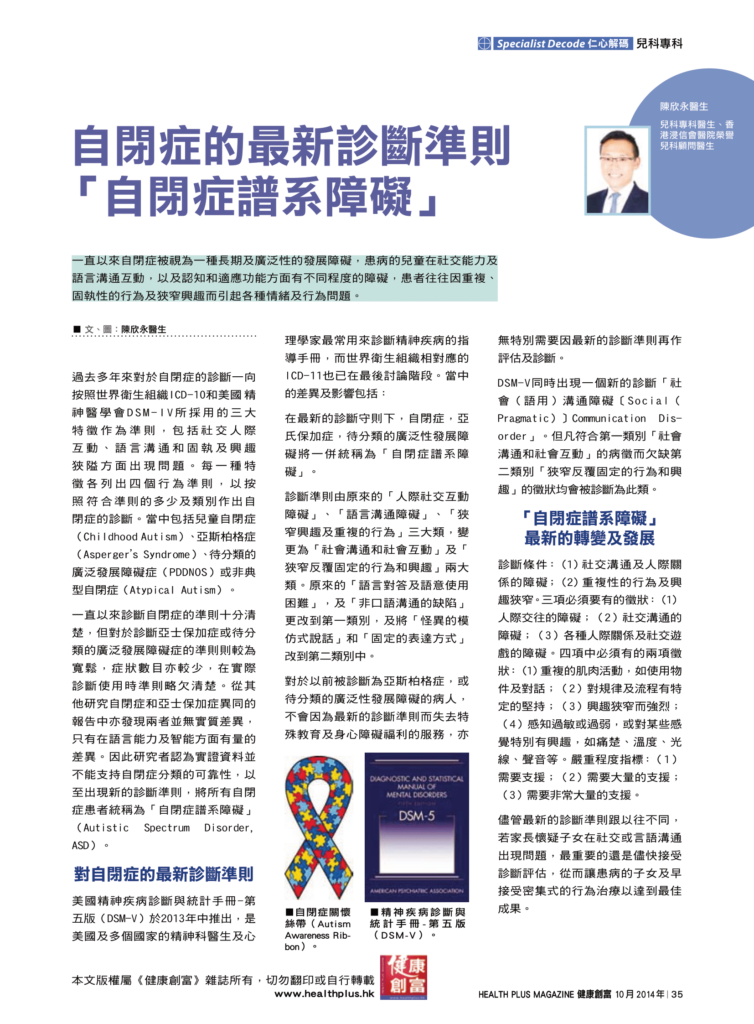
The Diagnostic and Statistical Manual of Mental Disorders – Fifth Edition (DSM-V), launched in mid-2013, is the most commonly used diagnostic manual for mental disorders amongst psychiatrists and psychologists in the United States and many other countries. The World Health Organization's corresponding ICD-11 is also in the final discussion stages. The differences and implications include:
Under the latest diagnostic code, autism, Asperger's syndrome, and pervasive developmental disorder not otherwise specified will be collectively referred to as "autism spectrum disorder".
The diagnostic criteria have been changed from the original three categories of "Disorders of interpersonal social interaction", "Disorders of language and communication", and "Restricted interests and repetitive behaviours" to two categories: "Social communication and social interaction" and "Restricted, repetitive patterns of behaviour, interests, or activities". The original "difficulties in reciprocal social interaction and conversation" and "deficits in nonverbal communication" have been moved to the first category, and "stereotyped or repetitive speech" and "insistence on sameness, inflexible adherence to routines" have been moved to the second category.
Patients previously diagnosed with Asperger's Syndrome or Pervasive Developmental Disorder Not Otherwise Specified will not lose access to special education and disability welfare services due to the latest diagnostic criteria, nor will they require re-assessment or re-diagnosis solely based on these new criteria.
The DSM-V simultaneously introduced a new diagnosis, "Social (Pragmatic) Communication Disorder". Any individual who meets the symptom criteria for category one, "social communication and social interaction", but lacks the symptoms of category two, "restricted, repetitive patterns of behaviour and interests", will be diagnosed with this disorder.
Latest changes and developments in Autism Spectrum Disorder
Diagnostic criteria: (1) Impairments in social communication and interaction; (2) Restricted and repetitive patterns of behaviour, interests or activities.
Three symptoms are essential: (1) difficulties in interpersonal interactions; (2) difficulties in social communication; and (3) difficulties in various interpersonal relationships and social games.
Two of the following four symptoms must be present: (1) repetitive motor actions, such as using objects and speech; (2) a specific insistence on routines and procedures; (3) narrowly focused and intense interests; (4) hyper- or hypo-reactivity to sensory input or unusual interest in sensory aspects of the environment, such as adverse response to sound, light, or texture, or fascination with lights, movement, or sounds.
Severity indicators: (1) requires support; (2) requires significant support; (3) requires substantial support.
Despite the latest diagnostic criteria differing from before, if parents suspect their children are experiencing problems with social or verbal communication, the most important thing is to undergo diagnostic assessment as soon as possible, so that the affected children can receive intensive behavioural therapy early on to achieve the best outcomes.
Dr. Chan Yan Wing, Paediatric Specialist