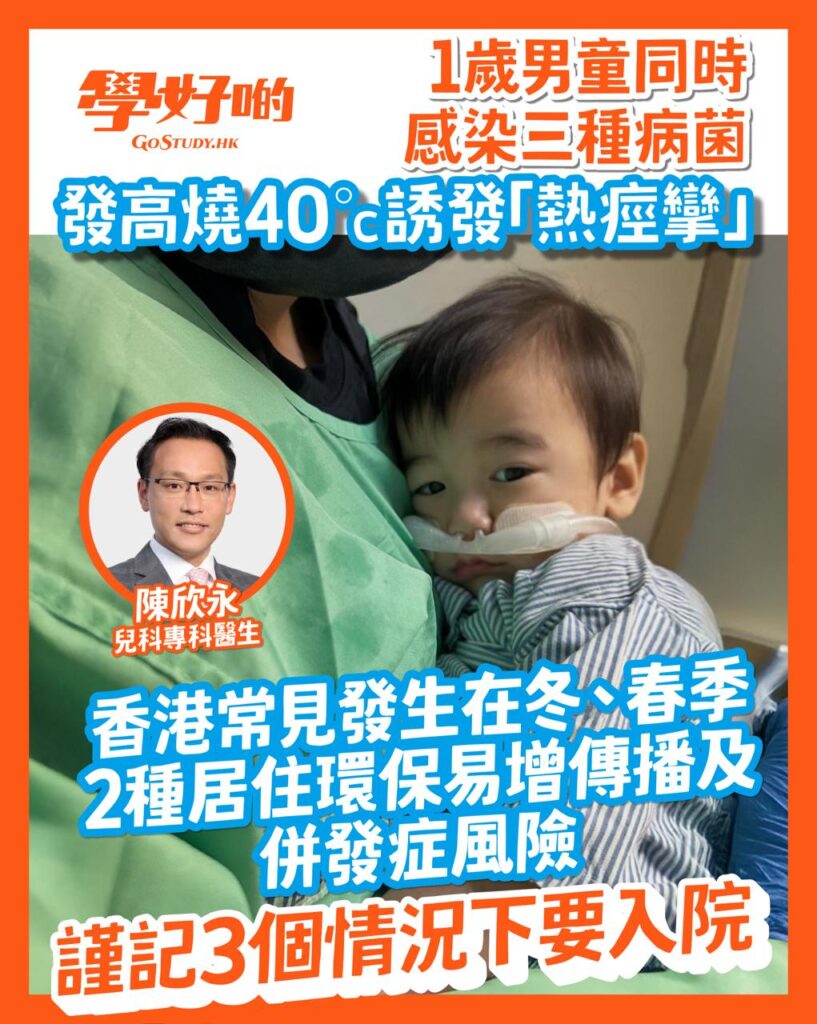
From being full of life to being on a ventilator in the intensive care unit, in just two days, a child was struck down by three types of germs. Taiwanese father Sean Chen shared his 1.5-year-old son's harrowing 12-day hospital experience after recently contracting adenovirus, RSV (respiratory syncytial virus), and pneumococcus. He reminds parents not to underestimate respiratory illnesses in young children. Hong Kong paediatrician Dr. Chan Yan-wing stated that Hong Kong's crowded living environment and air pollution also increase the risk of virus transmission and complications, advising parents to take extra precautions during winter and spring.

Sean noted that his son first presented with cold symptoms and a low-grade fever, which did not improve after seeking medical attention. After a second visit three days later, he was diagnosed with a co-infection of adenovirus and RSV, which led to bronchiolitis. At the time, his son's energy levels were still acceptable, and the parents opted for hospital observation. On the evening of the fourth day, his condition rapidly deteriorated, with chest retractions and wheezing. On the fifth day, his temperature rose to 39 degrees Celsius, and on the sixth day, a high fever of 40 degrees Celsius triggered a febrile seizure. Subsequently, his breathing worsened, and he was diagnosed with a co-infection of pneumococcal pneumonia, leading to his transfer to the intensive care unit for treatment with a high-level ventilator, steroids, and antibiotics. Fortunately, after 12 days of treatment, he was successfully discharged. Sean concluded by reminding parents to pay attention to six points:
- Adenovirus causes a high fever for 4-7 days.
- Young children with a high fever are prone to febrile seizures.
- Individuals prone to heat cramps should pay attention to their body temperature.
- RSV has a rapid course and easily causes pneumonia.
- No specific cure, only symptomatic treatment is available.
- The child's condition developed rapidly and should not be taken lightly. Although the child has now recovered, he urges parents to pay attention to every sign of discomfort and seek medical attention promptly.

When consulting with Hong Kong paediatric specialist Dr. Chan Yan-wing, Dr. Chan pointed out that adenovirus and RSV (respiratory syncytial virus) infections are quite common locally, particularly during the winter and spring seasons. These viruses can cause upper respiratory tract infections and may be accompanied by other bacterial infections such as Streptococcus pneumoniae.
Early symptoms include fever, cough, nasal congestion, and shortness of breath. If the condition is severe, such as persistent high fever or difficulty breathing, hospitalisation is required immediately. Parents should be familiar with methods for reducing fever and managing febrile seizures, and reduce the risk of complications through vaccination, good hygiene habits, and ventilation. Seeking medical attention early can reduce long-term effects.

Parents can pay attention to the following 5 points
1. Cases of adenovirus, RSV, and pneumococcal infection
In Hong Kong, infections by adenoviruses and respiratory syncytial virus (RSV) are relatively common, especially during winter and spring. These viruses can cause upper respiratory tract infections and may be compounded by other bacterial infections, such as *Streptococcus pneumoniae*. In recent years, due to climate change and environmental factors, such as crowded living conditions and air pollution, the risks of transmission and complications from these viruses have increased.
2. Early symptoms of adenovirus and RSV infections
Early symptoms include:
- Fever: Usually accompanied by other symptoms.
- Cough: dry or with phlegm.
- Runny or blocked nose: often accompanied by a sore throat.
- Shortness of breath or difficulty breathing: This is a warning sign to be aware of, especially with adenovirus infections.
The standard criteria for hospital admission include:
- Severe wheezing or difficulty breathing.
- The high fever is persistent.
- The medication is ineffective or the child appears extremely tired or inactive.
3. Cooling measures and heat cramp response
Specific cooling measures include:
- Physical cooling: Wipe the child with warm water, being careful not to use water that is too cold.
- Dress appropriately: Keep your child lightly clothed to prevent overheating.
- Replenish fluids: Encourage your child to drink plenty of water to prevent dehydration.
- If heat cramps occur again, parents should:
Ensure safety (e.g. place the child on a flat surface).
Do not forcibly restrain a child's limbs to avoid injury.
Time and seek medical assistance if the seizure lasts longer than 5 minutes.
4. Long-term effects of the virus on the lungs or immune system
Although most children recover completely from RSV and adenovirus infections, these viruses can affect the lungs in some cases, particularly in children with underlying health conditions. Some studies suggest that RSV infection may increase the risk of subsequent asthma, but this varies from person to person.
5. Methods to reduce the risk of complications
- Vaccinations: Get flu and pneumococcal jabs as advised by your doctor.
- Good hygiene practices: wash hands frequently, avoid contact with infected individuals.
- Keep the environment well-ventilated: Reduce indoor crowding and poor air circulation.
- As soon as you show symptoms of infection, seek medical attention promptly to prevent the condition from worsening.
Source: gostudy (2 December 2025)
https://gostudy.hk/46910/%e5%81%a5%e5%ba%b7/%e5%81%a5%e5%ba%b7-1%e6%ad%b2%e7%94%b7%e7%ab%a5%e5%90%8c%e6%99%82%e6%84%9f%e6%9f%93%e4%b8%89%e7%a8%ae%e7%97%85%e8%8f%8c-%e7%99%bc%e9%ab%98%e7%87%9240c%e8%aa%98%e7%99%bc/